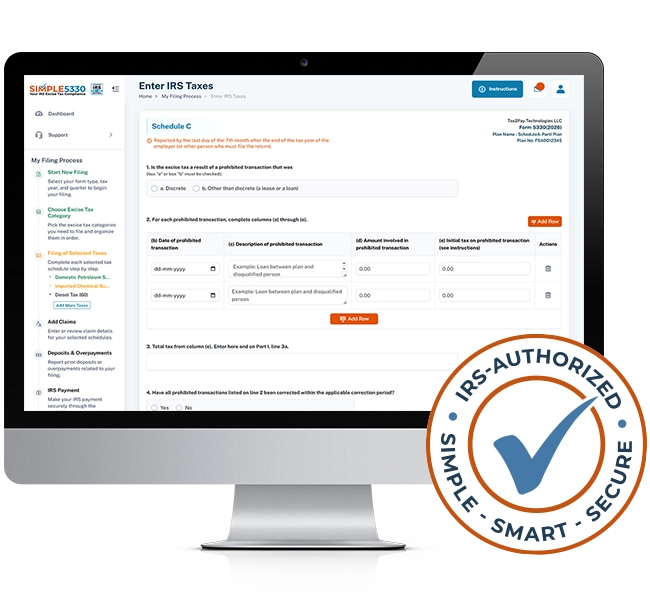
Form 5330

FORM 5330 OVERVIEW
What is IRS Form 5330?
Internal Revenue Service Form 5330 is used to report and pay excise taxes related to employee benefit plans.
It applies to violations under:
- Prohibited Transactions (ERISA)
- Late Contributions to Retirement Plans
- Excess Benefit Transactions
- Excess Contributions to Retirement Accounts
- Failure to File Required Forms like 5500 or 5500-SF
- Noncompliance with Required Minimum Distributions
- Failure to Correct Operational Failures
If your retirement or benefit plan has compliance issues, Form 5330 helps correct them officially with the IRS.
FORM 5330 FILING ELIGIBILITY
Who Needs to File IRS Form 5330?
Form 5330 must be filed by individuals or organizations responsible for correcting certain employee benefit plan violations and paying the related excise taxes.

Employers Sponsoring Retirement Plans
Businesses responsible for maintaining qualified employee benefit plans.

Plan Sponsors
Organizations that establish and maintain retirement plans for employees.

Plan Administrators
Professionals responsible for managing plan operations and compliance.

Plan Fiduciaries
Individuals who control or manage employee benefit plan assets.

Disqualified Persons
Individuals involved in prohibited transactions with the plan.

Employers with Late Contributions
Businesses that fail to deposit employee retirement contributions on time.
Tax-Exempt Organizations
Organizations involved in excess benefit transactions.

Pension Plan Sponsors
Employers who fail to meet minimum pension funding requirements.
Why Organizations Trust Us
Why Choose Simple5330?
The smarter way to file IRS Form 5330 online.
Simple5330 simplifies the filing of excise taxes related to employee benefit plans, making the process fast, accurate, and hassle-free for businesses, plan administrators, and tax professionals. With intuitive steps, built-in compliance checks, and accurate reporting, Simple5330 ensures smooth and efficient filing while reducing errors and saving valuable time..

Check System
Pricing Plans

Encryption

Dashboard
Retrieval

Support

Access

Download
Navigation
EXCISE TAX CATEGORIES
Types of Excise Taxes Covered
Form 5330 reports excise taxes under:
 Prohibited Transactions
Transactions between a plan and disqualified persons.
Late Employee Contributions
Failure to deposit employee deferrals on time.
Minimum Funding Violations
Failure to meet required funding standards.
Excess Contributions
Exceeding allowable limits for plans or participants.
Excess Benefit Transactions
Applicable mainly to tax-exempt organizations.
Form 5330 FILING DEADLINES
Important Deadlines and Penalties
for IRS Form 5330 Filing
Stay on Time to Avoid Costly Penalties
Filing Form 5330 on time is important to remain compliant with regulations set by the Internal Revenue Service. Missing the deadline can lead to additional penalties and interest charges on unpaid excise taxes.
 Filing Deadline
Form 5330 is generally due by the last day of the 7th month after the end of the plan year in which the taxable event occurred. Plan sponsors should track deadlines carefully to avoid late filing.
Late
Filing Penalties
If Form 5330 is filed late, the IRS may impose penalties and interest on the unpaid excise tax amount. The longer the delay, the higher the potential charges.
Avoid Penalties with Timely Filing
Using Simple5330 helps ensure accurate preparation, timely submission, and compliance with IRS requirements for reporting employee benefit plan excise taxes.
FAQs
GET STARTED TODAY
Ready to Simplify Your Form 5330 Filing?
Navigating Form 5330 requirements can be complex, but compliance doesn't have to be. Simplify excise tax reporting, reduce administrative burden, and stay on top of important filing obligations with a solution designed to support accurate and efficient compliance management.
Talk to Our Team